Immigration Reform Takes every other round in Congress

By // No comments:
the group of 8 Senators said in a joint announcement:

"Our immigration device is damaged and it's time for a country wide communique about how to restore it,"

"We agree with not unusual sense immigration reform is critical so that you can comfy america's borders, increase our economic boom, and offer fuller get admission to to the american dream."

The Immigration Reform schedule

the appearance of Senate Joint decision eight sent an uproar to the nation of California and forty nine other states in the U.S. The resolution subsidized by way of Senator Lou Correa (D-Santa Ana is directed at overhauling and supplying holistic ideas to address immigration reform issues for the benefit of around 11 million immigrants now in the US.

The move to introduce reforms in the immigration legal guidelines became first made by immigrant agencies in 2007 in the course of the reign of President Bush, however the movement become unsuccessful. again, the difficulty on reform immigration was revived in 2010 whilst President Barack Obama announced his deferred-deportation software allowing younger immigrants to use for work visas. In his kingdom of Union cope with in February, The President called on Congress to cope with the problem on immigration and pass widespread immigration measures.

Immigration a boost to American economy

according to Senator Huff, the us had benefited from immigration, "the united states has been enriched by using the electricity and lifestyle of immigrants who've come right here from everywhere in the world, and there may be no purpose to accept as true with that's changed," indeed, the decision is geared in the direction of growing a extra systematic and doable immigration reform mechanisms granting US citizenship to about eleven million unlawful immigrants in the US.

Senator Huff further stated that the us may be very a good deal privy to the need for reform immigration, accordingly, "it is flawlessly appropriate for the California kingdom Legislature to feature its voice to the ones reforms. Adopting those concepts will increase country wide safety and economic vitality within the country in addition to in California."

The "Gang of 8 Immigration Reform bill" profits aid

The U.S. Senate's bipartisan "gang of eight" includes the four Republicans specifically: Jeff Flake (Arizona), Lindsey Graham (S. Carolina), John McCain (Arizona) and Marco Rubio (R-Fla.) and four Democrats namely: Michael Bennet (Colorado.), Dick Durbin (Illinois), Robert Menendez (New Jersey) and Chuck Schumer (new york). They labored on the decision for months called "Gang of eight Immigration Reform bill." The invoice urges Congress and the govt branches of presidency to expand comprehensive and possible procedures to improve the country's immigration quarter thru workable immigration reform legislation.

The pass changed into supported by the non secular network and the economist organization. The maximum Rev. Gerald Wilkerson, auxiliary bishop of the Archdiocese of los angeles and President of the California Catholic conference expresses support to the plan of adopting sweeping reforms immigration. similarly, Vivek Wadhwa, Director of research for the center for Entrepreneurship and studies Commercialization stated that the growing number of visas issued to high-professional overseas employees could improve the U.S. financial system.

further, the San Diego city Council additionally declared their guide to the bill which surpassed a decision supporting the comprehensive immigration regulation. furthermore, the President Obama himself urged lawmakers to make immigration reform a priority time table for 2013.

The immigration reform rally

the call for immigration reform had escalated even greater with the participation of hundreds of usa citizens and non-americans in an immigration reform rally that occurred this 1st of may additionally 2013 in downtown la. at the same day, there are approximately 18 other states that rallied for reforms immigration which includes Washington, D.C. in which a huge crowd accumulated ultimate Wednesday afternoon at the west garden of the U.S. Capitol.

The combat of illegal immigrants inside the U.S. seems to be nearing its end. The aid of President Obama and Congress for immigration reforms will make a massive difference for the finest quantity of unlawful immigrants now within the U. S. They now have the chance to collect U.S. citizenship in simple and reachable terms and situations.

Lapsang Souchong Tea - Going beyond the bounds of Tea

By // No comments:

In state-of-the-art international, tea drinkers are trying to find a long way more than the average tea ought to offer and the Lapsang Souchong tea can supply precisely that.

The Lapsang Souchong tea is black tea with the aid of nature. it could be received within the form of black tea leaves, black tea powder or black tea luggage. but it's miles supplied, Lapsang Souchong tea is usually one of the nice unearths with regards to looking for the world's maximum excellent beverage.

The Lapsang Souchong tea is a black tea that originated from the Wuyi area of the chinese province of Fujian. it's miles known as the smoked tea because its leaves are usually smoke-dried over pinewood fires giving it a smoky flavor. there's quite an adventure tale at the back of the foundation of the Lapsang Souchong tea. it is believed that it was created all through the Qing technology. the annual drying of the tea on the hills of Wuyi turned into constantly interrupted via the crossing of soldiers. because of this, manufacturers of the tea demanded the workers to smoke-dry them instead the use of local pine woods. This gives the tea a sturdy smoky flavor that complements the herbal taste of the black tea.

The high-quality element approximately this particular blend of tea is the whole tea revel in doesn't best end once you empty your cup. The Lapsang Souchong tea is versatile and may be used in lots of ways besides consuming. it may be used as a marinade for roasted meat, a taste enhancer for ice cream in addition to with salty and highly spiced dishes.

In case you are curious approximately the procedure of making Lapsang Souchong tea, here's how:

1. Harvesting begins within the second week of may additionally in which mature leaves are picked to provide Lapsang.

2. to start the withering manner, the leaves are unfold over smoldering pine, o.k.or cypress tea embers.

3. next, they may be pan fried, rolled and placed in timber barrels to cause oxidation with a purpose to provide its candy aroma and colour.

4. lastly, they're hung over an oak, pine or cypress smoke to dry the leaves. This remaining procedure gives the tea its characteristic flavor.

like several teas, the Lapsang Souchong tea boasts of its very own list of wholesome blessings which include:

• It promotes wholesome weight reduction. The antioxidant assets of tea mixed with caffeine makes this viable because it will assist speed up your metabolism. it's going to additionally useful resource in the short burning of fats and building muscle tissues and as it has caffeine, you will cross about your day fully energized.

• It allows combat certain sorts of cancer. The mixture of catechins, polyphenols and vitamins aids in preventing loose radicals from destroying your DNA and lessens the boom of cancer cells.

• It protects your heart, decrease your blood strain and maintain sugar ranges.

• it is able to be a substitute for caffeine. rather than ingesting sturdy coffee with better caffeine content material to hold you conscious, make the Lapsang Souchong tea your alternative. It has lesser caffeine but sufficient to keep your thoughts alert. One excellent thing about caffeine in tea is that it's far continuously released on your system throughout the day so you will sense energetic.

The tasty Lapsang Souchong tea may just be the excellent black tea you will ever locate. The mixture of taste, aroma, health benefits and different uses of this tea will give you greater than you bargained for.

Ceylon Tea

By // No comments:

Until 1972 Sri Lanka turned into known as solely as Ceylon, accordingly tea is referred to as Ceylon tea. Tea on Sri Lanka started out to develop approximately in 1870, after destruction of coffee plantations because of a pandemic. Tea plantations of Ceylon are on highlands, - at an altitude from three hundred to 2500 meters.

Teas from Ceylon own firm taste, brilliant color of extract and the focused aroma. despite the fact that the Ceylon tea is plenty extra high priced tea then Kenyan and Bangladesh, it's far considered a far better product. in step with final document of Annual Tea assessment undertaking research of the Ceylon tea enterprise, reducing of volumes of manufacturing has started in the first quarter of 2007 and has been associated with the movement of the exchange unions combating to boom of wages after which strike had followed. As a end result trade unions have executed 33 percent boom of the earnings for employees of plantations. Such measure has led to increase of fee to fabricate of the Ceylon tea and increase of anxiety among producers approximately possible lower in profitableness. method for boom of profitability has been supplied. however such steps can cause an overabundance of manufacture of the tea. Annual Tea evaluate thereupon helps creation of the minimal fine trendy of Ceylon tea to improve first-class of manufacturing and therefore to restrict volumes of output.

In Ceylon there are 6 primary areas of cultivation of tea. Gaul - inside the south of island; Ratnapura - in 5 miles from capital Colombo; Kandy, located beneath ancient capital; Nuvara Elija - the maximum noticeably placed region in which the nice grow on Ceylon teas; Dambulla - to the West from the significant mountains; Uva - to the east from Dambulla. The tea developing in each of those areas possesses the specific taste, aroma and shade of infusion. The teas growing at top of 1500-1800 foots, vary lovely color a fort. middle mountain areas possess the saturated aroma and the expressed colour of infusion. The high-mountainous teas high-quality on Ceylon, are famous for delightful gold extract and rich aroma. On a few plantations grow so called «silver petals», tea with pale infusion of straw colour which need to in no way be drink with milk.

Lapsang Souchong - A sweet Tea scent and a traditional flavor to Die For

By // No comments:

you may undertaking any avid tea drinker to identify what tea gives off a different smoky taste and one sole option might sincerely pops out: Lapsang Souchong. tremendously hunted for its awesome scent, Lapsang Souchong tea is likewise known as Russian Caravan.

It being referred as such only because of the way it changed into transported to the marketplace. It goes to Moscow market through an overland travel from China that normally remaining approximately 365 days. a few claims that the smoky taste is a manifestation of being exposed to big range of campfires it will bypass along the way to Russian market.

another superb, even though a piece mythical, story explaining its particular aroma is the Fujian province lore. The name Lapsang Souchong sincerely approach smoky range. This special type of black tea belonging to Wuyi Bohea magnificence turned into determined by accident. This passed off in early China when a collection of military passing by way of the community of tea farmers disrupted the yearly drying of tea leaves.

To make certain sufficient supply, tea growers resorted quick alternatives to dry their tea leaves. subsequently, they opted for a smart alternative of setting tea leaves above fires made from local pines. This alternative resulted to a smoky aroma on the tea that by some means creative a superb attraction for tea enthusiasts. consequently, a inventive form of black tea become located and have become widely known until now.

Like other varieties of black tea, Lapsang Souchong is beneficial in allowing ease of blood go with the flow without facet consequences. The chemical composition of this tea also promotes mental cognizance. some other equally useful health effect of black tea is its contribution to performing 07b031025f5f96dfa8443f843db463b6 recuperation capabilities along the digestive tract.

This unique kind of tea is likewise sought for its healing effect specifically on situations associated with intestinal and gastric areas of the human body. Chemical components which include Tannins determined in this tea in regarded to stops diarrhea and decrease intestinal pastime.

different chemical components of this tea are regarded as powerful in preventing chelosterol related situations. Chemical compound like Theophylline can prevent ldl cholesterol build up by way of easing blood waft. moreover, this chemical is also vital to sufferers with bronchial asthma. Theophylline enables airway to make bigger consequently easing up the problem of respiratory among patients.

sooner or later, Lapsang souchong is likewise best when paired with highly spiced dishes. this is equally splendid whilst loved together with cheese. Its scent is likewise harnessed to assist out in developing a luxurious culinary masterpiece.

Last Annual Tea Tasting

By // No comments:
Enjoy these teas with my Honors students on Wednesday, December 12. From 3:20 to 4:10 that afternoon, we will be in the Atrium of the Conant Science Building (now known as DMF), where the Ben Linder Café could one day be located.

From China and Ceylon, by way of Tealuxe in Providence
clockwise from top-left
Golden Monkey Keemum (black)
Ti-Quan Yin Iron Goddess of Mercy (oolong) 
Dragon Pearl Jasmine (green)
Yalta Evergreen Estate Ceylon (black)
Background

I spent my 2012 sabbatical both learning more about coffee and expanding my interests to include tea. As part of that process, I was an informal observer at a meeting of the U.N. Intergovernmental Group on Tea. The meeting was much smaller than I expected -- even the hotel staff did not know what it was. The convener welcomed the 38 attendees as the "Captains of Tea." Plus me, the Coffee Maven. I think I was one of four U.S. citizens at the meeting, and I still remember a delegate from India who, when I asked how many people worked for him casually replied, "one-point-two." Meaning 1,200,000 tea workers!
IGG-Tea Climate Committee: Serious business in a casual setting
I spent part of that meeting as an observer of the Committee on Climate change, a top tea agronomist from each of three major producers: India, Sri Lanka, and Kenya. We gathered around the pool where they wrote -- and allowed me to provide some input as a geographer -- a preliminary plan for the global tea industry to respond to climate change. The Captains of Tea adopted the plan unanimously, a pleasant surprise in the city that is the principle locus of climate deniers on the planet. That experience led me to offer a one-credit honors colloquium, with the intention of helping the IGG-Tea to implement that plan.

This proved far too ambitious for a one-credit class, but the students enjoyed learning about both tea and climate change, so I continued to offer the course as an opportunity to explore both topics. I did so with increasing attention to the notion of climate justice, which I learned about from Dr. Mary Robinson during that same sabbatical.

Each semester since the autumn of 2013, students in this colloquium have explored tea, climate change, and the relationships between the two. They have done a variety of projects in response, and in the past couple semesters have had a terrific new resource: the IGG-Tea group has published a final report. It is quite different from what we envisioned, but in many ways more useful and robust. Students this semester have been delving into that report and will be presenting some of its more interesting findings in our brief tasting event.

Lagniappe

This "last annual" tasting is also the first to be offered by students, though I did provide a tea tasting for faculty colleagues at the CARS Celebration in 2013. The Tea & Climate Change colloquium has had a good run, but after 11 semesters it is time to move on. I could offer a class on chocolate, but instead will use the colloquium to explore a great city that I know only from afar: New Orleans, A Global City.

Calling on Congress

By // No comments:
Jamal Khashoggi of was a journalist working for the Washington Post when he was ambushed and assassinated in the Saudi consulate in Istanbul on October 2. It was immediately clear that the murder was ordered by Saudi crown prince Mohammed bin Salman. It was less clear how the United States government would react.

Almost immediately, the president of the United States began offering alternative theories and excuses, but the evidence that one of his key allies was involved was overwhelming, and his efforts to postpone taking a stand eventually ran out. This happened over the weekend, when the CIA confirmed what we all knew about the killing. The president dismissed, demurred, and finally declared his real opinion on the matter: he simply does not care that his allies killed this journalist. The economic relationship with Saudi Arabia and its alliance against Iran are more important, he said, than the death of this journalist.

To be fair, he is not the first U.S. president to prioritize economic considerations over human rights when it comes to the Saudi royal family and similarly-situated despots. It has been the norm for generations of our leaders, in fact. The difference this time arises from several factors: the extreme cruelty of the killing, the targeting of a journalist, the president's ongoing rhetorical support for such targeting, the abuse of the sanctity of consular spaces, and most importantly the ongoing killing in Yemen.

Saudi citizen Khashoggi was killed because he was critical of the war on Yemen. "Standing with" Saudi Arabia in this context means continuing to condone and support the most egregious war crimes, while again signaling that the killing of journalists will be tolerated by this president.

Further, the economic interests that have clouded the judgment of previous U.S. pale in comparison to the personal financial interests that motivate the current president. The emoluments clause of the U.S. Constitution was written specifically to ensure that the president's first allegiance would be to this country and its values.

Fortunately, members of Congress in both parties have spoken out strongly against the recent statements by president and his Secretary of State, and have rightly pointed to the influence of the odious John Bolton, who always seems to advocate the most dangerous and inhumane course of action. Of course, all of the critics in the president's own party have spoken like this before, and after a single news cycle they have returned to giving the president whatever he wants.

This time it is important to show Congress that the president does not speak for his country on this issue; that we do not stand with the Saudi royal family. For this reason, I have written to my own member of Congress, and I hope others will do the same. Below is the full text of the letter I sent to Rep. Stephen Lynch late last night. Some members are already starting to organize just such investigations; they will need encouragement to keep at it.


Dear. Rep. Lynch:

I am writing to ask that you use whatever investigative tools you and your colleagues may have available to investigate the involvement of the Trump administration and/or the extended Trump family in the brutal killing of U.S.-based journalist Jamal Khashoggi.

At a minimum, the president's constant verbal assaults on the media may have given the Saudi royal family the impression (apparently correct) that the administration would condone whatever cruelty they carried out on this poor man. It seems also quite possible that some intelligence about Mr. Khashoggi was shared with the regime.

Whether there was any cooperation before the fact, the president has behaved very much like an accessory after the fact of this killing, doing all he could to protect the Saudi royal family.

Today he has asserted that his support for the Saudi regime is about greater economic and security concerns. Given his numerous business connections to the family, this is implausible, and an insult to the intelligence of the American people. I hope you will investigate whether his misplaced loyalty constitutes a gross breach of the emoluments clause of the Constitution.

If the Congress does not confront the president in the strongest of terms, I fear for the safety of journalists both abroad and at home. Five were brutally murdered in my old home town of Annapolis, one credibly threatened in Boston, and more attacked with pipe bombs, all by individuals who believed themselves to be carrying out the intentions of the president. In each case, he has been very reluctant to correct their impressions.

For these reasons, I believe that the Khashoggi case is not only a tragedy and a moral affront, but also an existential crisis for our country. I hope investigations can be pursued vigorously. Meanwhile, I hope that the Congress can make it clear that the country does NOT stand with the Saudi regime.

Thank you for your consideration.

This Way or the Highway?

By // No comments:
Followers of this blog (see especially my 2017 Unicorn Cult post) and innocent bystanders to my various rantings will know that I am more than a little dubious about the powers of markets to solve problems in the real world.

I was therefore surprised by my own reaction to journalist Kara Miller's conversation with urban-planning professor Michael Manville, in which he offers a market-based approach to the pernicious problem of traffic.

Related links are on the Innovation Hub's blog post for this story.

The conversation begins with laments about traffic from person-on-the-street interviews in Chicago and Atlanta -- two cities in which I have spent hours stuck in their legendary traffic jams and in which it was easy to find ordinary people with extraordinarily strong feelings on the subject. Their discussion includes cogent description of the environmental, health, and economic costs of congestion. It then turns to things that have been tried -- adding capacity, improving public transit, high-density development -- and examples of places that have done these extremely well without putting a dent in traffic.

What to do? Professor Manville argues that congestion results from underpriced capacity. At first this sounds like the nonsense I heard from economists when I first started studying deforestation in the Amazon. The difference is that Manville's argument arises from a carefully defined notion of capacity and a feasible means of adjusting its price; neither of these obtained in the vague free-market pronouncements I was hearing about the Amazon.

His analysis recognizes the importance of a characteristic of traffic that is not obvious from casual observation: the relationship between traffic count (number of cars) and congestion (average speed) is non-linear. Double traffic on a nearly empty road at midnight, and travel time is not affected at all. Double it again, and slowing might be minimal. Eventually, though, traffic will be running at something close to its capacity, beyond which an increase of just a few cars might slow traffic dramatically. Average speeds might drop from 60 to 15 with the addition of just 5 percent more cars. To get a 4x improvement in travel time, we do not need 4x capacity or to remove 3/4 of the cars. Getting just 5 percent of cars off the road at a peak time would be sufficient.

A related insight is his reference to roads as real estate. Driving a car is like renting a moving piece of land measuring about 0.002 acre. We are used to paying rent if we park the car -- maybe the equivalent of thousands of dollars per acre per day. But when the car is moving, we rarely pay rent. And if we do, that rent is the same any time of day.

What Manville suggests is that this rent should fluctuate with its real value -- quite low or even zero when traffic is light, but quite high as a road reaches capacity. He draws compelling comparisons to other situations in which supply is kept available by flexible pricing, and he makes quite a bit of sense. He addresses questions of equity in two ways: first, he points out that there is already a great deal of inequity involved in transportation. It is already much more comfortable to travel as a rich person than as a not-rich person.

Second, he suggests that it is common for the rich who pay premiums for convenience to be subsidizing the poor. This is where the actual application of his ideas should receive the most careful attention. For example, revenue from the peak-time charges could be applied to public transit or to information technologies that would make it easier for average-income commuters to time-shift.

Attitude Adjustment

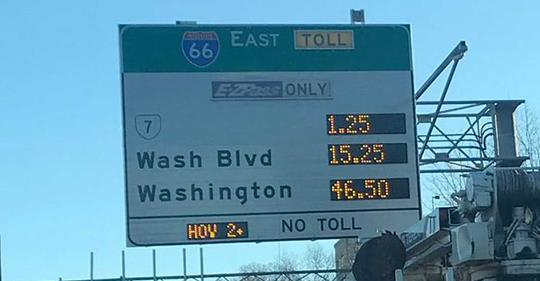
I had my first encounter with this concept in 2016, in a story from my home town, Washington, D.C. This photo was circulating, showing an extraordinary (to my thinking) toll on a toll lane parallel to the public highway my father took to work when I was a kid.
My reaction -- which I posted online -- was mistaken. I assumed that this was a private alternative to the public road, simply a way for the rich to opt out of congestion and for companies to profit from what should be a public service.

This was before I learned the general lesson of reading things more carefully before posting about or sharing them, and long before the more specific lesson of how these are supposed to work. The Washington Post article highlights a couple of key considerations. First, a vehicle with just one extra passenger would pay no toll at all. Second, the tolls are collected by the public agency that managed the highway. Third, the tolls are updated every 6 minutes, providing the dynamism that Professor Manville was proposing, but the price shifts are so dynamic that drivers sometimes swerve out of their lanes at the last minute to avoid them. Causing more congestion.

For this approach to work, it seems, a way must be found for pricing to be sufficiently dynamic while also being communicated in a way that does not yield sudden surprises.

Whatever one concludes about this approach to traffic control, Professor Manville's work -- and his discussion of it with journalist Kara Miller -- are excellent examples of the spatial thinking that is central to modern geography.